Mold Growth After Water Damage in Morse Reservoir: 48 Hour Rule
It usually starts quieter than you would expect. A supply line under the kitchen sink gives way overnight, or a storm pushes water through a basement window during one of those heavy Morse Reservoir downpours, and by morning you are standing on damp carpet wondering how bad this really is. The honest answer is that the clock started the moment the water hit your floor. At Morse Reservoir Water Restoration, we have walked into hundreds of homes across central Indiana where the visible water was the smaller problem, and the bigger problem was already forming inside the wall cavities, under the baseboards, and on the back side of the drywall. That problem is mold, and the timeline is shorter than most homeowners realize.
The industry standard, taught through IICRC training and echoed by the EPA, is that mold can begin colonizing wet materials within 24 to 48 hours. That is not a marketing line meant to scare you into calling someone. It is a biological reality tied to spore behavior, humidity, and the kind of organic material your home is built from. We founded Morse Reservoir Water Restoration in 2018 to give Morse Reservoir homeowners a straight answer when they are panicking at 11pm, and the straight answer here is that if your property has been wet for more than a day, you are already in a race. If we cannot help, we will tell you directly. But you need to understand what you are actually fighting.
How quickly does mold actually start growing after a leak?
Visible mold colonies typically begin forming between 24 and 48 hours after materials become wet, assuming indoor temperatures stay in the comfortable range most Morse Reservoir homes maintain year round. The spores themselves germinate even faster. Within 12 hours of contact with standing water, drywall paper and wood framing can begin supporting active fungal growth at a microscopic level. You will not see anything yet. You will not smell anything yet. But the colonies are establishing.
By hour 48, those colonies become visible to the naked eye as fuzzy patches, usually starting near the floor line on drywall or along the bottom edges of cabinets. By day three to four, sporulation begins, which means the mold is now actively releasing reproductive spores back into your air. That is the point where a contained water event becomes a whole house indoor air quality problem.
Temperature and humidity accelerate or slow this timeline. A Morse Reservoir home sitting at 70 degrees with 60 percent relative humidity is essentially an incubator. Drop the humidity to 40 percent and the same colony slows dramatically. Push the temperature into the 80s, as often happens when a leak goes undetected during a vacation with the AC turned up, and the timeline compresses to as little as 18 hours for visible growth.
What materials in my Morse Reservoir home are most at risk?
Porous and semi porous materials are mold magnets. Drywall paper, carpet pad, insulation, particleboard, MDF cabinetry, and untreated wood framing all absorb water deeply and release it slowly. These are the materials that need the fastest attention. A soaked carpet pad in a Morse Reservoir basement can still be wet two weeks later if you only ran a household fan on it.
Hardwood floors sit in a middle category. Solid oak can sometimes be saved with aggressive professional drying if the response happens within the first 48 hours. Engineered flooring is much harder to rescue because the plywood substrate delaminates. Tile, glass, sealed concrete, and metal are non porous and rarely support mold growth directly, though the grout lines and substrates underneath them often do.
Cabinet kickplates and the toe kick area under bathroom vanities deserve special mention. These spaces trap water against MDF or particleboard for days while the visible cabinet face looks perfectly dry. We routinely find advanced mold growth inside cabinet bases in Morse Reservoir kitchens where the homeowner thought a dishwasher leak had been handled. The same goes for the back side of baseboards, where capillary action pulls water up from the floor and holds it against the drywall for weeks.
Can I just dry it out myself with fans and a dehumidifier?
Sometimes, yes. If the water was clean (Category 1, from a supply line or rainwater), the affected area is small (under about 10 square feet), and you can verify with a moisture meter that materials are returning to normal levels within 48 hours, a careful DIY dry out can work. We have told Morse Reservoir homeowners exactly this when their situation warranted it.
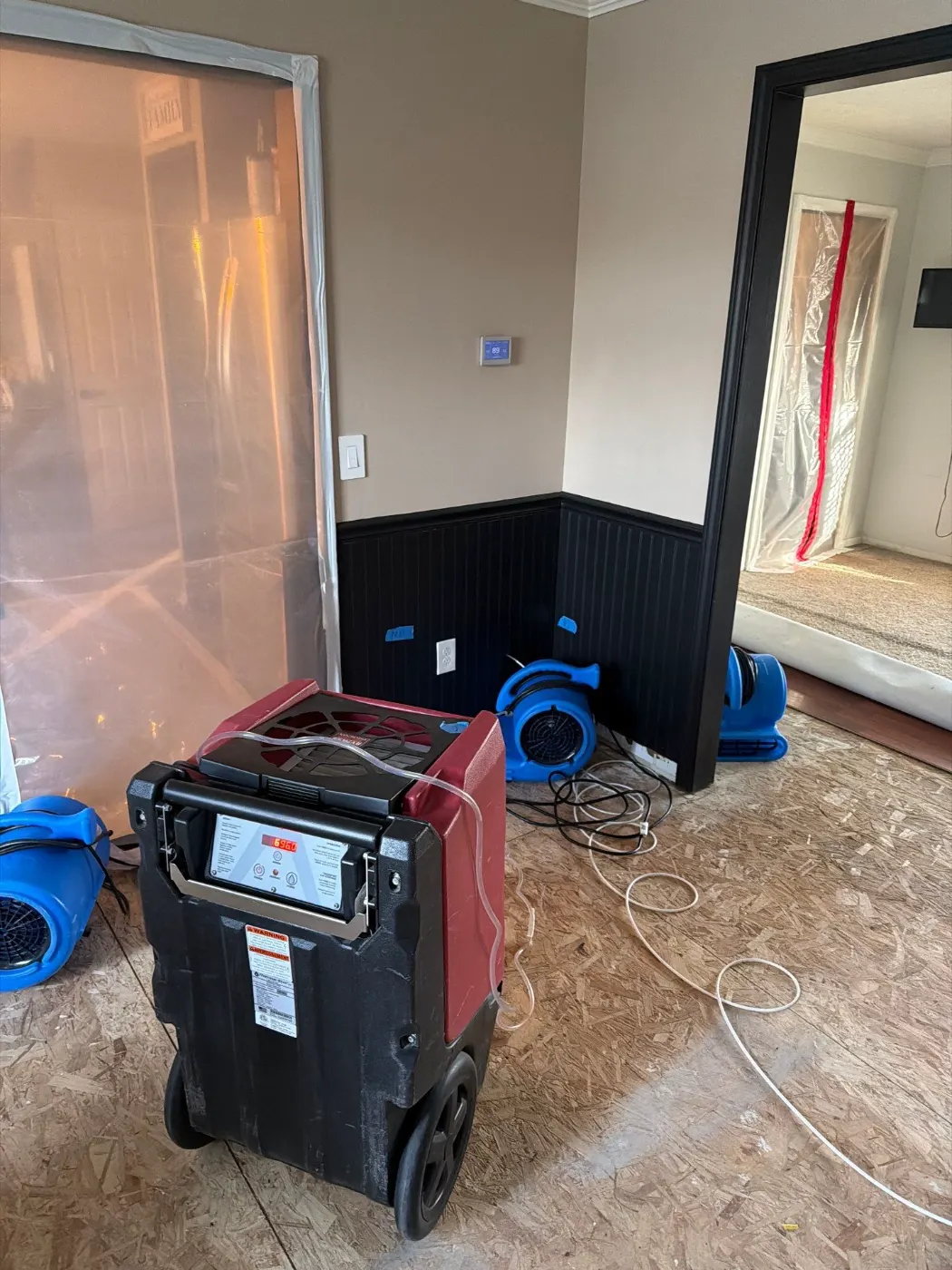
The problem is that most homeowners do not own moisture meters or thermal cameras, and standing water almost always migrates further than it looks. Water wicks up drywall 12 to 18 inches above the visible waterline. It travels under baseboards into adjoining rooms. It pools inside wall cavities where your box fan cannot reach. Professional equipment, including truck mounted extractors, low grain refrigerant dehumidifiers, and air movers placed at specific angles, removes water faster than the 48 hour window allows mold to establish. Our breakdown of professional drying timelines shows what realistic targets look like.
Why is the 48 hour rule so important for insurance claims?
Your homeowners policy almost certainly covers sudden and accidental water damage, like a burst supply line or a failed water heater. What it usually does not cover is secondary damage caused by your delay in addressing the problem. If an adjuster determines that mold growth occurred because you waited a week before calling anyone, they can deny the mold portion of your claim entirely and sometimes reduce the water damage payout as well.
Documenting fast action protects your claim. When Morse Reservoir Water Restoration arrives, we photograph moisture readings, log the affected square footage, and provide a written scope that aligns with insurance language. That paper trail matters. For more detail on what your policy likely covers, our breakdown of homeowners insurance and water damage walks through the common exclusions and the language adjusters look for.
What should I do in the first hour after discovering water?
Stop the source if you can do it safely. Shut off the main water valve, kill power to affected circuits at the breaker, and move belongings out of standing water. Take photos of everything before you move anything. Call your insurance carrier to open a claim number, then call a restoration company. In Morse Reservoir, Morse Reservoir Water Restoration typically reaches most addresses within 2 hours of the initial call, often faster during business hours.
Do not pull up wet carpet yourself unless you have a place to dry it. Do not cut into drywall unless you know there is no live electrical or plumbing in that cavity. Do not run your HVAC system if water has entered the ductwork, because that spreads spores throughout the whole house.
Call Before the Clock Runs Out
If your Morse Reservoir home or business has taken on water in the last day or two, the right move is to get eyes on it now, not tomorrow. Morse Reservoir Water Restoration has been serving central Indiana since 2018, we are BBB A+ rated and IICRC certified, and our team will tell you honestly whether you need full restoration or whether you can handle the drying yourself. Either way, you will know where you stand. Call us anytime, day or night, and we will start the clock in your favor instead of against you.
How much does fast response actually save?
A typical water mitigation job in a Morse Reservoir home, addressed within the 48 hour window, runs roughly $2,500 to $6,500 depending on square footage and materials. The same loss, addressed at day five or six after mold has colonized, often runs $8,000 to $20,000 or more because the scope now includes containment, HEPA filtration, antimicrobial application, removal and disposal of contaminated materials, and post remediation verification testing. The math favors the phone call.
What are the early warning signs mold has already started?
The first sign is almost always smell. A musty, earthy odor that was not there before, especially noticeable when you walk in from outside, means active microbial growth somewhere. The second sign is visual: discoloration on drywall, dark spots on the underside of subflooring visible from a crawl space, or fuzzy patches behind furniture pushed against an exterior wall.
Less obvious signs include a sudden uptick in allergy symptoms, headaches when spending time in specific rooms, condensation on windows that did not fog before, and warping or bubbling of paint or wallpaper. Any of these warrant a call. Our detailed guide on mold after water damage covers the testing and remediation steps in depth.
Does the type of water source change the timeline?
It changes everything. Category 1 water (clean supply line water) carries minimal microbial load on arrival, so the mold timeline is essentially the standard 24 to 48 hours. Category 2 water (gray water from dishwashers, washing machines, or aquariums) already contains bacteria and nutrients that feed faster fungal growth, often producing visible colonies in 18 to 24 hours. Category 3 water (sewage backups, flood water, prolonged stagnant leaks) is contaminated on contact and can produce visible biological growth within 12 hours.
The category also dictates what materials can be saved. Category 1 affected drywall might dry in place successfully. Category 3 affected drywall must be removed regardless of how dry it gets, because the contamination is now embedded in the material. That distinction is why a sewage backup in a Morse Reservoir finished basement always costs more to remediate than an equally sized supply line break upstairs, even when the square footage is identical.
Frequently Asked Questions
How fast does mold really grow after water damage in Morse Reservoir?
Under typical Morse Reservoir indoor conditions, mold spores begin germinating on wet cellulose materials within 24 to 48 hours. Visible growth usually appears between days 3 and 7 if drying has not started.
Can I just dry it out myself with fans?
For a small, clean water spill caught immediately, household fans can help surface materials. For anything involving drywall, carpet padding, subfloor, or hidden cavities, you need commercial air movers and dehumidifiers. Morse Reservoir Water Restoration can assess in person and tell you honestly if DIY is enough.
Will my insurance still pay if mold has already started?
Usually yes, if you can show prompt action once the damage was discovered. Delays of several days often trigger mold sublimits that cap payouts. The faster you document and call, the cleaner your claim.
What if the water damage happened a week ago and I am just now noticing mold?
Call Morse Reservoir Water Restoration for an inspection. We will test moisture levels, identify affected materials, and give you a clear remediation scope. Mold this far along typically requires containment and selective demolition, but it is fully recoverable.
How quickly can Morse Reservoir Water Restoration get to my Morse Reservoir property?
For emergencies in Morse Reservoir and surrounding Central Indiana communities, we target arrival within 60 to 90 minutes of your call, 24 hours a day. Faster response means less damage and a smaller bill.
Have a restoration question?
Our IICRC certified Morse Reservoir crew is ready to help. Free assessments, estimate based on what we can sees, no pressure.